By digitising physical instruments, Cheque Truncation Systems (CTS) were created to speed up the clearing of checks. However, many banks still face a recurring “grid” issue in CTS operations even after years of operational maturity.
There is no technological flaw in this grid. Strict clearance deadlines, exception-heavy procedures, and manual dependencies all contribute to this operational bottleneck.
Banks are finding that typical process optimisation is no longer adequate as cheque volumes vary between cycles.
At this point, AI becomes a strategic tool rather than a tactical solution for CTS Grid Challenge scenarios.
Banks can alleviate systemic congestion without sacrificing control or compliance by directly integrating intelligence into document processing and validation stages.
What is the CTS Grid Challenge in Banking?
The CTS grid challenge refers to the operational congestion that occurs when cheque processing volumes collide with manual intervention points under rigid clearing deadlines.
In a typical CTS environment, grids emerge due to:
- Sequential, human-led validation workflows
- High dependency on manual data entry and verification
- Large exception queues during peak clearing windows
- Limited ability to process cheques in parallel
This grid is most visible during:
- End-of-day and end-of-cycle clearing
- High inward cheque inflows from clearing houses
- Outward cheque submissions from multiple branches
The impact is immediate and measurable:
- SLA breaches and delayed settlements
- Increased rework and operational fatigue
- Higher financial and compliance exposure
- Reduced transparency across processing stages
At scale, the CTS grid becomes unsustainable. This is why AI for CTS Grid Challenge is increasingly being discussed not as innovation, but as infrastructure.
How Can AI Solve CTS Processing Issues?
Traditional CTS environments rely on rules, manpower, and post-facto reconciliation. AI changes this model by introducing real-time intelligence into the processing flow.
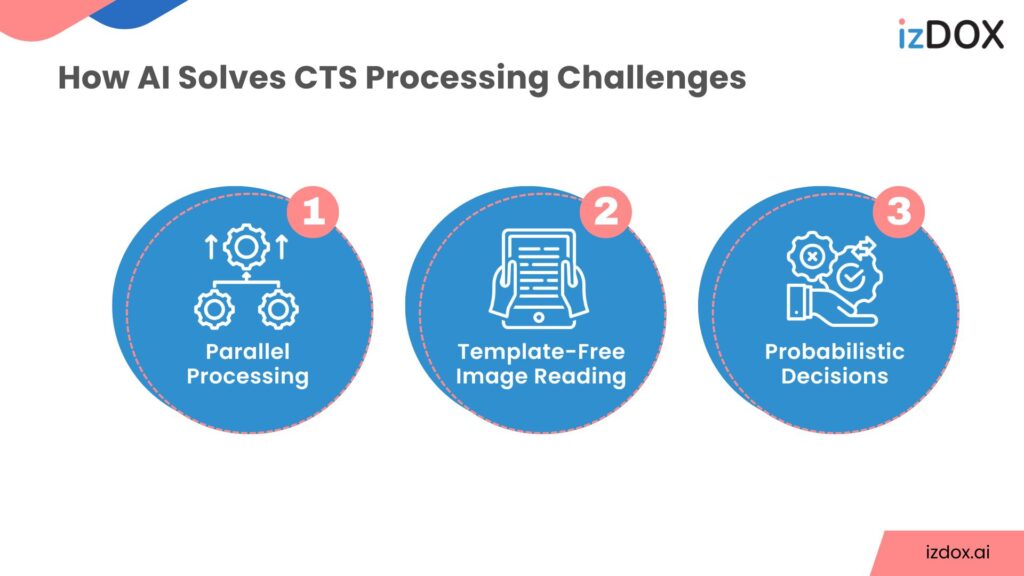
AI addresses core CTS challenges by:
- Replacing linear workflows with parallel processing
- Interpreting cheque images without rigid templates
- Making probabilistic decisions instead of binary rule checks
Instead of pushing exceptions downstream, AI resolves most issues at source.
This shift is central to AI automation for CTS operations, where decisioning happens during ingestion rather than after gridlock has already formed.
AI Solutions for CTS Clearing and Settlement
AI-led CTS solutions operate across both inward and outward clearing cycles, enabling banks to automate end-to-end cheque handling.
Core capabilities typically include:
- Automated cheque classification:
- Inward vs outward instruments
- Post-dated and stale cheques
- Inward vs outward instruments
- Template-free data extraction:
- Amount
- Date
- Account details
- Payee information
- Amount
- Amount validation:
- Cross-checking words and figures
- Logical and contextual verification
- Cross-checking words and figures
From a settlement perspective, AI ensures:
- Faster readiness for clearing windows
- Reduced dependency on last-mile manual checks
- Seamless integration with existing CTS and core banking systems
Platforms such as izDOX exemplify this approach by embedding AI directly into document workflows, rather than layering automation on top of legacy processes.
This is where Intelligent document processing for CTS becomes a foundational capability, not an add-on.
How AI Improves Cheque Truncation Systems
AI improves CTS not by replacing controls, but by strengthening them at scale.
Key improvements include:
- Improved processing velocity
- Faster turnaround times within clearing cycles
- Consistent performance during peak loads
- Faster turnaround times within clearing cycles
- Reduced manual touchpoints
- Lower dependency on human validation
- Fewer handoffs across teams
- Lower dependency on human validation
- Higher data accuracy
- Fewer mismatches
- Reduced rework and corrections
- Fewer mismatches
From a governance standpoint, AI-driven CTS workflows provide:
- Complete audit trails
- Time-stamped decision logs
- Transparent validation paths
These capabilities allow banks to modernise cheque truncation systems without diluting regulatory discipline. This balance is central to successful AI for CTS Grid Challenge implementations.
Role of AI in CTS Reconciliation and Exception Handling
Reconciliation is often the most resource-intensive phase of CTS operations. It is also where grid challenges silently accumulate.
AI reshapes reconciliation by:
- Assigning confidence scores to extracted data
- Auto-clearing high-confidence transactions
- Routing only genuine exceptions for review
This enables a maker–checker model that is:
- Focused on value-added decisioning
- Supported by AI recommendations
- Backed by explainable logic
Benefits of AI-led exception handling include:
- Reduced false positives
- Lower exception volumes
- Faster resolution cycles
- Continuous learning from resolved cases
Through AI automation for CTS operations, reconciliation moves from reactive correction to proactive prevention.
AI-Powered Grid Resolution in Banking Operations
The true value of AI lies not in managing gridlock, but in eliminating its root causes.
AI-powered grid resolution enables banks to:
- Process cheques in parallel rather than sequentially
- Anticipate bottlenecks before they escalate
- Scale operations without linear cost increases
Strategic outcomes include:
- Lower operational risk
- Improved customer experience through faster settlements
- Greater resilience during volume spikes
By embedding intelligent document processing for CTS into core operations, banks move from grid management to grid avoidance.
This shift is essential as cheque volumes remain significant even in increasingly digital ecosystems.
Final Perspective
The CTS grid challenge is no longer an operational inconvenience. It is a structural limitation of manual, exception-heavy systems operating under modern scale.
AI for CTS Grid Challenge scenarios demonstrates that intelligence, when applied at the document and decision layer, can unlock speed, accuracy, and compliance simultaneously.
For banks, this is not about adopting new technology.
It is about future-proofing a critical clearing function with systems designed for volume, scrutiny, and time-bound execution.
AI-led CTS automation represents a decisive step towards that future.