
Historically, trade finance has viewed speed and compliance as a zero-sum game, where accelerating transactions often meant compromising on compliance risk, and rigorous compliance inevitably degraded the customer experience. However, as global trade grows in complexity and customer expectations soar, banks can no longer afford this trade-off.
Banks must now deliver a seamless, integrated experience that maintains total regulatory integrity. The key to bridging this gap lies in the use of artificial intelligence. Using AI based workflows, banks can fundamentally reengineer the entire trade finance journey of customers.
Keep reading to learn more.
What is Trade Finance Compliance?
Trade finance compliance refers to the frameworks, controls, and validation processes that ensure every trade transaction adheres to regulatory, legal, and institutional requirements.
These include:
- Pre-Processing: Ensuring that all documentation aligns with specific transaction types while extracting critical data points for validation.
- Validation: AI-driven checks for UCP 600, ISP98, URC 522, URDG 758, URDTT compliance specific to transaction types, ensuring document consistency.
- Screening: Simultaneous sanctions and embargo scanning.
- Approval: Final verification against internal risk policies before the transaction is finalized.
Unlike other banking products, trade finance is heavily document-driven. Critical trade instruments—including invoices, bills of lading, inspection certificates, and guarantees, and many more—demand absolute data consistency across disparate formats, jurisdictions, and counterparties.
Even minor discrepancies can trigger delays, rejections, or financial exposure. As trade volumes increase and documentation grows more complex, manual compliance checks become unsustainable.
By embedding artificial intelligence at the heart of end-to-end trade finance, compliance has evolved beyond its traditional back-office roots to become a primary driver of institutional strategy and competitive advantage.
Why is Compliance Critical in Trade Finance Customer Journeys?
While compliance processes are often invisible to the customer, their operational consequences are starkly visible. Friction points such as chronic delays, redundant document requests, and unexpected rejections disrupt working capital cycles and strain supplier trust
A slow or fragmented compliance process often feels like poor service, even when the intent is risk mitigation. Conversely, weak compliance that prioritises speed can expose banks to financial loss and regulatory scrutiny.
This is why AI-driven compliance is now synonymous with a premium customer experience. By integrating intelligence throughout the end-to-end workflow, banks eliminate the traditional friction of the final compliance checkpoint, delivering speed and security in tandem.
How Does AI Improve Trade Finance Processes?
Artificial intelligence fundamentally reshapes trade finance operations by substituting repetitive, high-risk manual tasks with sophisticated, cognitive workflows that ensure precision at scale.
In an AI-centered trade finance model, process excellence is redefined through the following advancements:
- Cognitive Data Extraction: Transforming unstructured documents into structured data via machine intelligence.
- Algorithmic Validation: Applying uniform AI logic to ensure consistent ICC and UCP adherence.
- Predictive Detection: Identifying discrepancies at ingestion for immediate, early-stage resolution.
- Knowledge Institutionalization: Embedding domain expertise into AI to minimize individual dependency.
- Parallel Processing: Replacing sequential handoffs with simultaneous, near real-time AI checks to ensure speed in the process.
Crucially, AI fosters inherent predictability by stabilizing turnaround times and shifting exception management from a reactive posture to a targeted, proactive discipline. Compliance checks run continuously instead of at isolated checkpoints.
When implemented effectively, artificial intelligence sharpens compliance vigilance while fundamentally elevating the human role. By offloading routine verification, specialized teams can reallocate their expertise toward nuanced risk interpretation, complex exception management, and high-value customer engagement.
How can Banks Balance Speed and Compliance in Trade Finance?
The equilibrium between velocity and compliance necessitates a fundamental reorientation of the operating model. The objective is neither accelerated processing at the cost of oversight, nor exhaustive verification that paralyzes commerce; rather, the mandate is intelligent orchestration.
Banks achieve this balance by:
- Embedded Validation: Integrating complex logic directly into the transactional lifecycle to ensure real-time alignment with ICC and UCP standards.
- Confidence-Based Routing: Utilizing AI-driven scoring to prioritize human intervention for high-complexity cases, optimizing specialized human capital.
- Systemic Throughput: Leveraging machine intelligence to finalize low-risk, high-volume transactions instantaneously.
- Audit Transparency: Generating immutable digital trails for every decision to ensure comprehensive regulatory accountability.
In advanced digital trade environments, artificial intelligence facilitates a state of continuous compliance. Documentation—including invoices, bills of lading, and guarantees—is validated at the point of ingestion, with discrepancies flagged instantly.
This structural transformation redefines the customer journey. Clients benefit from accelerated response times and reduced friction, while banks maintain a standardized compliance posture across all global jurisdictions and product lines.
Frameworks built on cognitive intelligence such as those pioneered by izDOX demonstrate how artificial intelligence aligns operational velocity with uncompromising regulatory discipline at scale.
The Strategic Impact of AI in Trade Finance Compliance
When viewed strategically, artificial intelligence driven compliance delivers value far beyond operational efficiency. It reshapes how banks compete, serve customers, and manage risk.
Key strategic outcomes include:
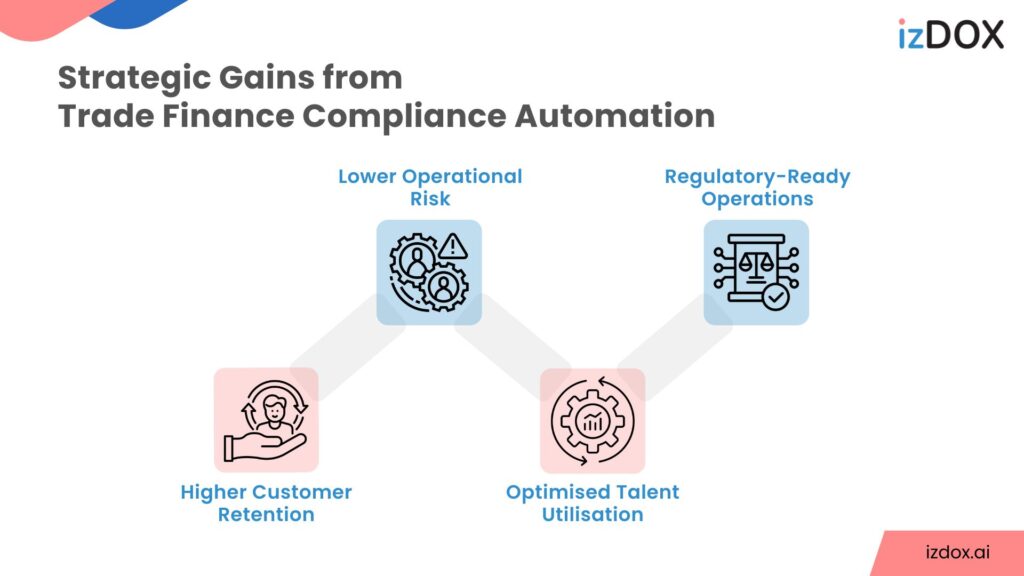
- Improved customer retention through faster, more reliable service
- Reduced operational risk through consistent rule enforcement
- Better utilisation of skilled compliance and operations talent
- Increased readiness for evolving regulatory requirements
As global trade becomes more interconnected and digitally driven, banks that invest more in artificial intelligence will be better positioned to scale without compromising trust.
Conclusion: AI Driven Compliance with Speed
Realigning the trade finance customer journey around artificial intelligence, banks can deliver experiences that are simultaneously rapid, secure, and resilient. Ultimately, the integration of artificial intelligence is not merely a pursuit of velocity; it is a commitment to advancing with institutional control, systemic confidence, and customer trust as the primary drivers.
Discover how the artificial intelligence frameworks of izDOX.ai empower trade finance teams to accelerate processing without compromising the integrity of compliance.